
Imagine this.
You walk into a bank and apply for a loan.
You have a good salary.
You have a stable job.
You feel confident.
But the bank says:
“Your credit score is too low.”
And suddenly, nothing else matters.
That’s how powerful a credit score is.
Let’s understand it in simple words.
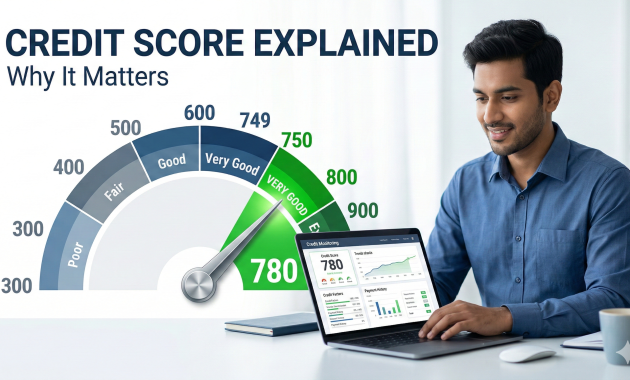
What Is a Credit Score?
A credit score is a 3-digit number that shows how trustworthy you are with borrowed money.
In India, this score usually ranges between:
300 to 900
The higher the number, the better your credit profile.
Think of it like a financial report card.
Just like in school:
- High marks = good reputation
- Low marks = warning signal
Banks check this number before giving you:
- Personal loans
- Home loans
- Credit cards
- Car loans
What Is Considered a Good Credit Score?
Here’s a simple idea:
- 750 and above → Very good
- 700–749 → Good
- 650–699 → Average
- Below 650 → Risky
If your score is above 750, banks are more likely to:
- Approve your loan faster
- Offer lower interest rates
- Give higher credit limits
A small difference in score can save you thousands in interest.
Why Does Credit Score Matter So Much?
Because banks don’t know you personally.
They don’t know:
- Whether you are responsible
- Whether you pay on time
- Whether you manage money well
Your credit score tells them that story.
It answers one question:
“Will this person repay on time?”
What Affects Your Credit Score?
Many people think it’s random.
It’s not.
Your credit score is mainly affected by:
1. Payment History
If you pay EMIs and credit card bills on time, your score improves.
If you delay payments, even by a few days, it can hurt your score.
This is the most important factor.
2. Credit Utilization
If your credit card limit is ₹1,00,000 and you use ₹90,000 regularly, it looks risky.
Experts suggest keeping usage below 30–40% of your limit.
Lower usage shows better control.
3. Too Many Loan Applications
Every time you apply for a loan, it gets recorded.
If you apply for many loans in a short period, it signals financial stress.
That can lower your score.
4. Credit History Length
The longer your credit history, the better.
Old credit cards (used responsibly) actually help your score.
Closing old cards sometimes reduces your score.
Common Mistakes That Damage Credit Score
Let’s talk about real-life mistakes.
❌ Missing one EMI and ignoring it
❌ Paying only minimum credit card amount regularly
❌ Taking too many “Buy Now Pay Later” options
❌ Co-signing someone else’s loan without thinking
❌ Ignoring small overdue amounts
Even small mistakes can affect your score for years.
How to Improve Your Credit Score (Step by Step)
The good news?
Credit score is not permanent.
You can improve it.
Here’s how:
Step 1: Pay Everything On Time
Set reminders.
Use auto-debit.
Don’t miss due dates.
Consistency is powerful.
Step 2: Reduce Credit Card Usage
If your limit is ₹1 lakh, try to keep usage below ₹30,000–₹40,000.
This single habit improves score faster than people expect.
Step 3: Don’t Apply Everywhere
If one bank rejects you, don’t immediately apply to five more.
Wait. Improve score first.
Step 4: Clear Old Dues
If you have pending small amounts, clear them.
Even a ₹500 overdue can hurt your score.
Step 5: Be Patient
Credit score improvement takes time.
Usually, you may see positive changes in 3–6 months with disciplined behavior.
Does Checking Your Own Credit Score Reduce It?
No.
Checking your own score (soft inquiry) does not reduce it.
But when a bank checks it during a loan application (hard inquiry), that can have a small impact.
So checking your own score regularly is safe.
Final Thought
Your credit score is like your financial reputation.
You may not see it every day.
But lenders see it before making decisions.
It affects:
- Loan approvals
- Interest rates
- Credit card limits
- Even some job background checks
Managing your credit score is not difficult.
It just requires:
- Discipline
- Awareness
- Consistency
A good credit score gives you options.
And in finance, options mean power.
